
I'm leaving the pictures below because I like them but please do NOT do as I did back in 2011. I no longer dig up the plants, just harvest a leaf. Just as delicious and much more sustainable. Thanks, Eve
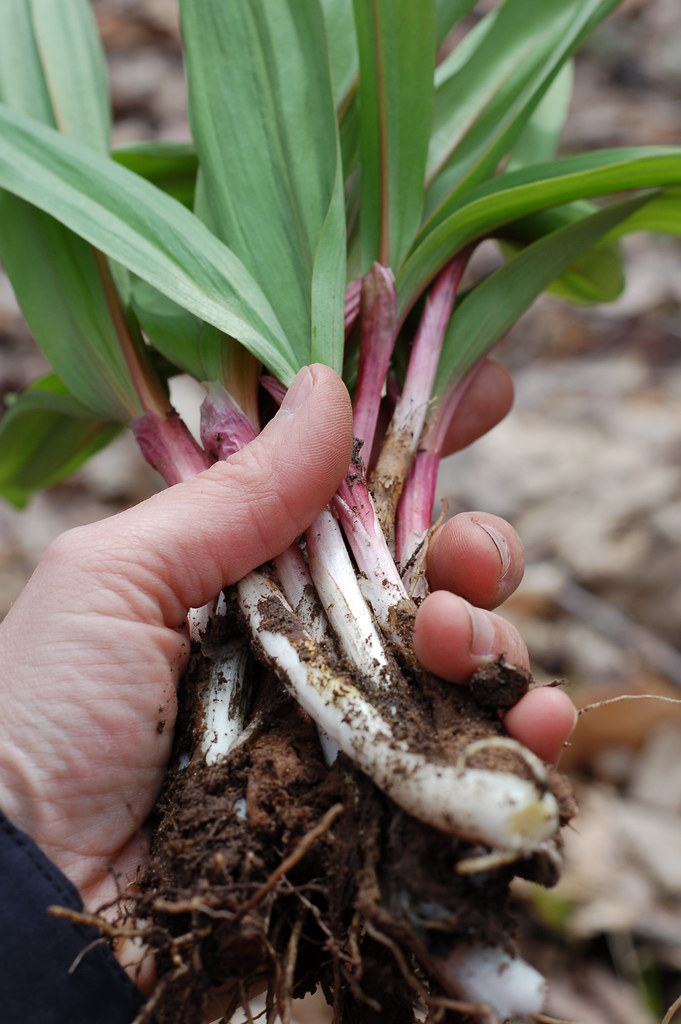
I've been eagerly scanning the roadsides and woods the last few weeks in the hopes of spotting some of these elusive wild ramps everyone's been raving about. After several frustratingly fruitless walks in the woods and along stream beds, I finally hit pay dirt the other afternoon - a whole hillside!

Maybe it was the build-up from all those weeks of seeking or the thrill of finding something green and edible growing after this endless, snowy winter, but finding them was a moment of pure excitement and elation.

I fell in love right away, before I'd even dug the first plant out of the ground or had a chance to taste one.

They're such beautiful plants. I think they look just like a cross between a Lily of the Valley and an onion. Strong but slender with green leaves and a beautiful purple stem and "seam" that runs partway up the leaves. Perhaps, like me, you're not terribly familiar with this lovely native plant. Allow me to introduce you. Their Latin name is allium tricoccum but they're more commonly known as ramps, spring onions, ramsons, wild leeks, wild garlic, and, en Français, ail sauvage and ail des bois.
Ramps are perennials and grow in groups with their scallion-like bulbs firmly rooted beneath the soil. They favor sandy, moist soils and are often found near streams though you might also find them carpeting the forest floor where beech, birch, poplar and/or sugar maple trees are found.
If you spot some plants that you think fit this bill, you can test your identification by tearing off a leaf and giving it a sniff -- it should smell strongly of onion/garlic.

If you are lucky enough to find some, please be respectful. Due to the fact that the demand for these wild plants has been ramping up (sorry, I couldn't help myself) in recent years, there are growing concerns about overharvesting. If you want to know more, read this recent New York Times article on the topic. The good news is that these things are potent so a small amount goes a long way.
Harvest only from large, healthy beds and restrain yourself to snipping a single leaf from each plant. Do not dig up the whole plant!
I strongly suggest starting your own ramp patch(es) if you have appropriate land, as well. We have both transplanted a small amount of plants to our property and also purchased established plants and seeds from the good folks at the Ramp Farm. Our patch is thriving!
It will probably take a number of years before you have enough to harvest but keep on spreading those seeds and you'll be there before you know it.
Harvest only from large, healthy beds and restrain yourself to snipping a single leaf from each plant. Do not dig up the whole plant!
I strongly suggest starting your own ramp patch(es) if you have appropriate land, as well. We have both transplanted a small amount of plants to our property and also purchased established plants and seeds from the good folks at the Ramp Farm. Our patch is thriving!
It will probably take a number of years before you have enough to harvest but keep on spreading those seeds and you'll be there before you know it.
You'll want to use a trowel or hoe in order to unearth them without damaging the bulb.

Keep the plants you've harvested cool and moist (you can just leave them in some dirt, if you like) while you pick.
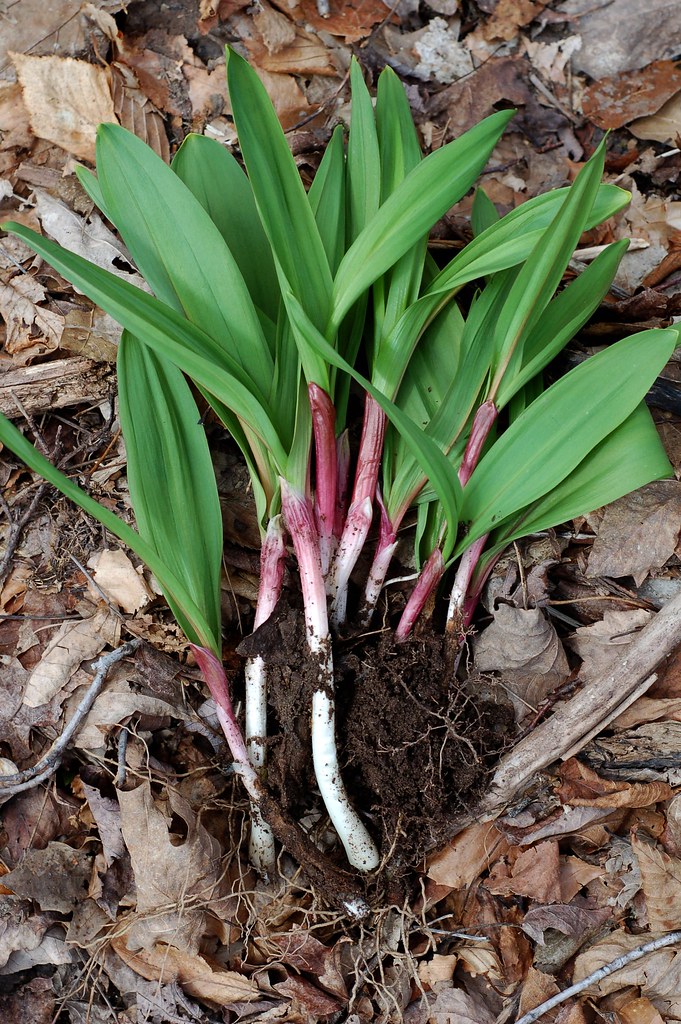
Once you've finished your sustainable harvest, take them home and clean them up.

Peel off the papery skin, use cold water to wash off the dirt, and use a sharp knife to remove the roots, leaving the entire bulb intact. Dry them carefully with a towel to remove all the water, then bundle them together to help retain moisture and store in the refrigerator.
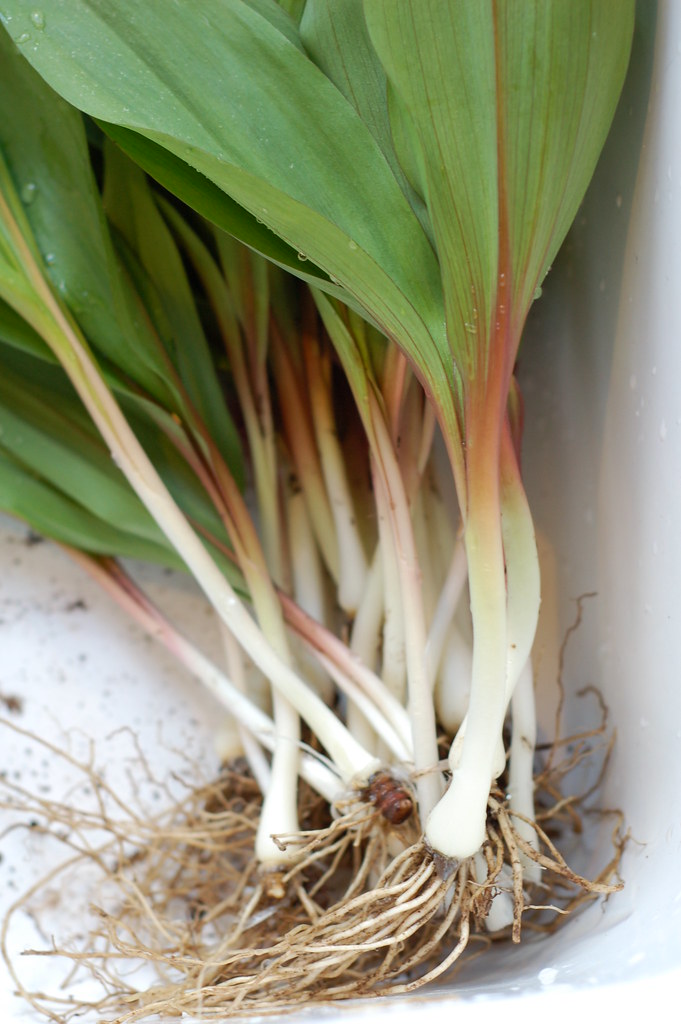
Just when you thought things could not possibly get any more fun, it's time to decide what to cook with them! There are a lot of good options. Although you can eat them raw, keep in mind that they are a bit intense -- if you don't like raw onions, scallions or garlic, you're not going to like raw ramps. But their strong, garlicky flavor is enhanced by cooking - it becomes mellower and sweeter.
Based on my research and on my own experiments, I'm happy to report that ramps are excellent grilled, sautéed, roasted, pickled and in pesto. If you're not feeling super adventurous, one basic rule of thumb is that you can use ramps for anything you would normally use onions or garlic.

I will be posting a recipe for the delicious wild ramp and parsley pesto we made the other night just as soon as I can and I also have plans to make a wild ramp and lemon risotto and will keep you posted on that.

In the meantime, I will leave you with the delicious-looking ramp recipes below.
You might like:
Some Other Wild Ramp Recipes:
- Spaghetti With Sautéed Ramps & Bread Crumbs from The Amateur Gourmet
- Wild Leek Pesto From Hunter Angler Gardener Cook
- Linguine With Ramp Pesto & Seared Salmon from Bon Appetit
- And a few more options from Simply Recipes


23 comments:
Nice tutorial! Sadly, no ramps where I live in NorCal, but we do have three-corned leeks, which are almost as good...
Great tutorial! Sadly, no ramps where I live in NorCal, but at least we have three-corned leeks, which are similar, if not quite as good.
Thank you! I am a big fan of your blog. I wish I'd known about these three-corned leeks you mention before we left Northern Cali last summer to move back east. Ah well...
That's what we call Bärlauch here in Switzerland. Great stuff and you can pick it by the ton in the spring. You have to pick it in forested areas to be safe. There is a similar looking plant, Herbstzeitlose, that is quite poisonous but only grows in sunny meadows and on forest edges. Sometimes city slickers mix them up and end up dead. Great tutorial. Thanks
Thanks for underscoring the need for moderation of harvesting these lovely wild plants. It is so often the case with wild foods that even when everyone takes a little ( <15 percent)--they ultimately get whittled down.
Do you know, can people plant ramps in woodland backyards and get their own patches growing?
Wouldn't that be a great project?
In our Oregon yard, we have a patch of three-cornered leeks. They are notoriously invasive, but in April, they make for great omelets and soups.
Hi Ann, yes, a definite need to to be sensitive in harvesting. And YES, you can certainly plant your own (in fact, I literally just did that half an hour ago). You can order both seeds and bulbs from these folks and plant away! They like hardwood forests (no pines) and fairly shady with sandy, loamy soil. It takes them a while to get going, apparently, but if you know you'll be in a place for some years, it seems totally worthwhile to me!
I just finished harvesting some ramps this evening. I don't pull up the plant, I always cut it off at ground level with a pair of kitchen sheers and over the years I've watched my prized patches flourish and spread! I like to cut them up and dehydrate them for use in soups and sauces. They are delicious in spaghetti sauce!! And of course Hubby and I will have them in some scrambled eggs in the morning!! Love your blog!
Thanks, Carmen! I love your idea of using just the greens to ensure the health and longevity of the plants, too! Did you plant your own?
Always just take the leaves. They don't divide very quickly.
Please only cut the leaves. If you persist in digging up the whole plant, there soon will be none left!!!
I made the risotto...since I'm such a risotto fanatic. This was such a great way to use ramps!! Thank you!
Sustainability
According to the USDA, ramps are listed as “special concern, commercially exploited”. In Quebec commercial harvesting is illegal, and personal harvesting is limited, but there are still commercial ramp "poachers". Many states in the United States are noticing a deterioration of local ramp populations, mostly due to commercial harvesting, and "Ramp festivals". Some of these festivals attract as many as 35,000 tourists to small Appalachian towns.
Ramp plants take 7 years to reach maturity where they can produce seeds. However, they can reproduce via rhizomes (part of the roots) or from the bulbs splitting into two. As a result, the most sustainable way to harvest them is to never take the bulb! The leaves are just as flavorful, if not more so, and have a more appealing texture. Never buy plants that have the bulb, or eat at restaurants that feature the whole plant. Try to encourage others not to dig up or use the whole plant. (I pulled one here by accident, but it helps with identification purposes). Never take more than one leaf from the plant. Only harvest from large, well-established flushes (patches) of plants, and never take from more than 25% of the plants. The flowers and "mini bulbs" that form from them are also edible, but I would advise against it, again, for perpetuation of the species.
Many experienced foragers will say things like "only take 25%/15%/ etc." but the fact remains, there is no science behind these statements. The only scientific study I have found indicates that if you take 25% of the population, it takes 20 years to recover. Essentially, harvesting any bulbs is unsustainable practice.
I'm confused, you say just pick one leaf, but the bulb is the tastiest part! Your pictures show while Ramps, bulb and all. Please advise. If you clip below the bulb, and leave the stringy roots, will that be more sustainable?
Hi Music Cellar,
you must have missed this bit at the very top of the post, I am guessing? Hopefully, this explains it. Just clip a leaf from each - not the bulbs (even though they are delicious...) Hope that clarifies things. Best, Eve
----------------------------------
UPDATE: April, 2016 - Due to growing demand for this wild delicacy, slow-growing ramps are quickly becoming endangered. Do NOT dig up a whole plant - instead, cut just one leaf from a plant and leave the rest. Better yet, plant some ramp seeds or order some starts from the Ramp Farm to create your own patch.
I'm leaving the pictures below because I like them but please do NOT do as I did back in 2011. I no longer dig up the plants, just harvest a leaf. Just as delicious and much more sustainable. Thanks, Eve
There was a small patch of ramps on a family friend's land about 15 years ago. Have been just pulling them in the spring since. Sometimes u get the just leaves, sometimes the whole works. Now cover about 3 acres. Seems like if you just pull and not dig they come up perfectly white, that is if you get anything besides leaves. We tried to put a trail down to a lake back in the woods 5 years ago and used some of the gravel from along the yard as a topcoat now ramps are in trail. You say there is a need for sustainable harvesting. So think about this.. Don't dig or cut at the base. Pull and be happy with what you get. They have layers just like onions. However when you pull them they seem to detach and leave their outer layer and roots behind.
Hi, I live in lower Hudson Valley, where would be a good place for me to forage for ramps? I'm in Ossining NY.
Hi Edward,
sadly, I do not know that area at all. I think your best bet is to reach out to folks who forage in your neck of the woods. Or just try some places they might like. Best of luck and remember to harvest sustainably.
Ed-
Anywhere in the hardwood forest without thick underbrush. Stick to gullies and damp areas...
We can grow our own Ramps. Seeds can be ordered, gathered and/or bulbs can be transplanted.
https://content.ces.ncsu.edu/cultivation-of-ramps-allium-tricoccum-and-a-burdickii
http://ediblecolumbus.ediblecommunities.com/recipes/wild-ramp
When we harvest Ramps we leave those on the outer edges. By harvesting in the middle we have watched them fill back in much more quckly. (Still takes years.) We leave the final inch of the bulb and the roots intact and in place. Takes a few years but they do grow back. Seems clear ot me that each person must carefully examine their areas over the years then formulate and follow a sustainable harvest plan - even on Public lands. In our experience some areas have few, small patches. Others have an unbroken carpet of Ramps as far as the eye can see. Quite obviously our harvesting must be altered to reflect each situation.
Happy Trails Y'all!
Be aware of poisonous look alikes.
Links to some of the poisonous look alikes of Ramps (Allium tricoccum):
https://plants.usda.gov/core/profile?symbol=MAST4
https://plants.usda.gov/core/profile?symbol=COMA7
https://plants.usda.gov/core/profile?symbol=COMA19
https://plants.usda.gov/core/profile?symbol=IRIS
https://plants.usda.gov/core/profile?symbol=VEVI
This webpage contains more links and information:
https://en.m.wikipedia.org/wiki/Allium_ursinum
Pleas be careful about look alike. The first few photos here look like Lily of tge valley to me, leaves that whorl into single stem etc...
They're definitely ramps! I ate them and they were ramps.
You didnt read the whole article did you Ann?
Post a Comment