Hainanese Chicken with Rice - A Fresh, Flavorful Meal

Thursday, August 7, 2014

Hainanese chicken with rice by Eve Fox, the Garden of Eating, copyright 2014

In my neverending quest to use up the cucumbers that are spilling out of our garden on a daily basis, I remembered this lovely dish that I had not made in many years. It's a variation on a one-pot meal that yields a beautiful, composed salad served with a gingery dipping sauce that is so fresh and flavorful that's rather addictive.
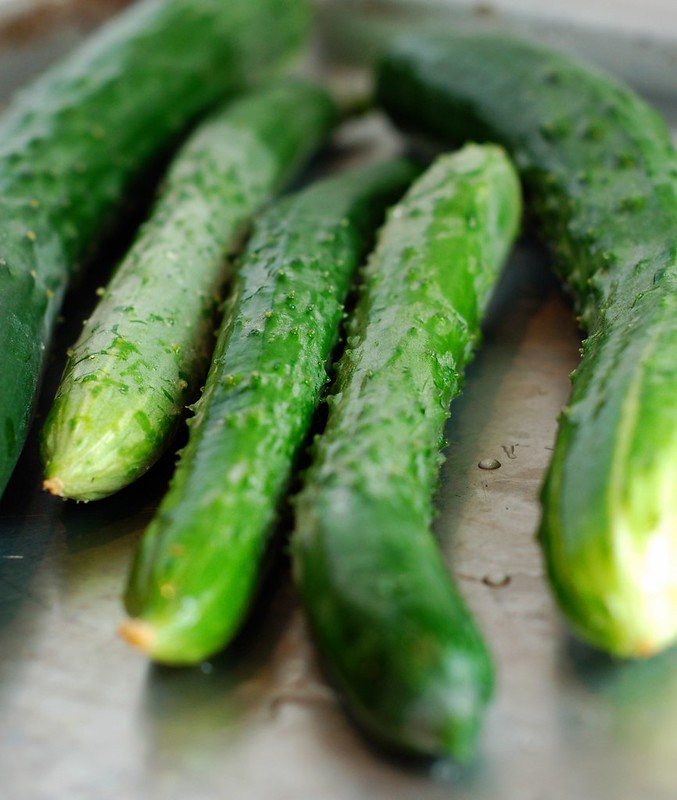
Cucumbers from the garden by Eve Fox, the Garden of Eating, copyright 2014

The recipe hails from the island of Hainan in the South China Sea and variations on it are also popular in Thailand, Malaysia and Singapore. I learned about it via a Mark Bittman column in the New York Times back in 2008.

In addition to being a very tasty way to showcase a bunch of fresh-picked, wonderfully crunchy cucumbers, it's a lovely way to feed a crowd. It earned rave reviews when I made it for dinner recently.
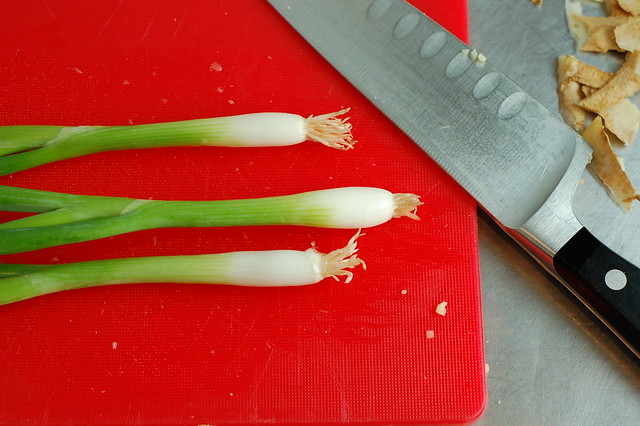
Scallions by Eve Fox, the Garden of Eating, copyright 2014

I love the mix of flavors - ginger, garlic, scallions, cilantro - and the mix of textures - crunchy cucumbers, juicy tomatoes, tender, poached chicken.
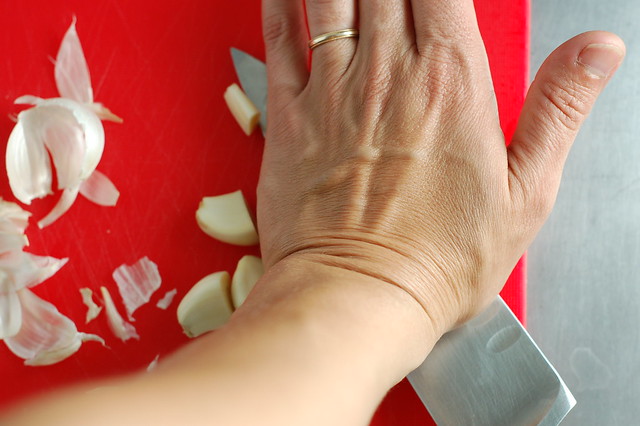
Smashing garlic by Eve Fox, the Garden of Eating, copyright 2014

The concept is simple. You start by poaching a whole chicken in a big pot of gingery, garlicky water. Then you take the bird out to cool, leaving you with a big pot of gingery, garlicky chicken stock.
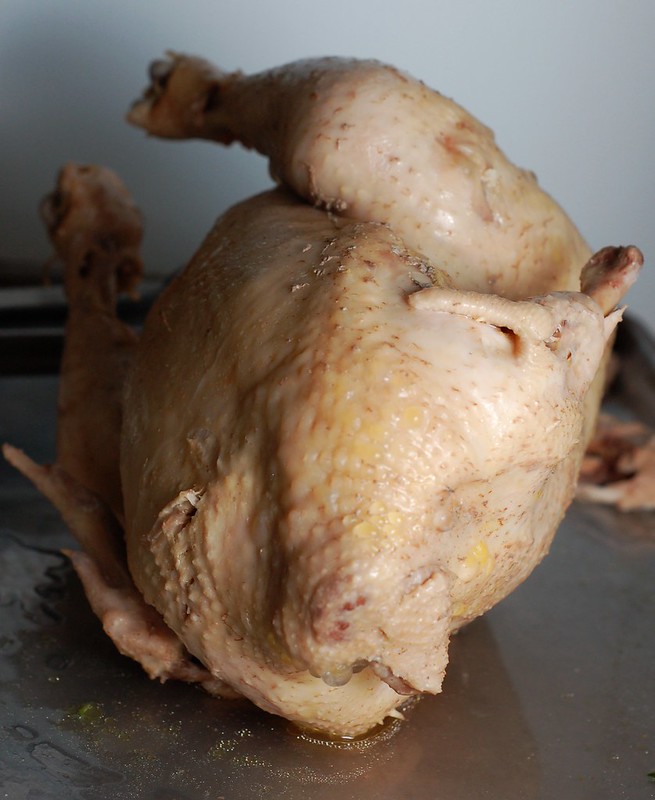
Poached chicken by Eve Fox, the Garden of Eating, copyright 2014

Next you cut up some shallot or onion and garlic and sauté them for a few minutes before adding the rice and sautéing that for a minute or two. Then you add some of that nice, flavorful stock you've created in lieu of water.
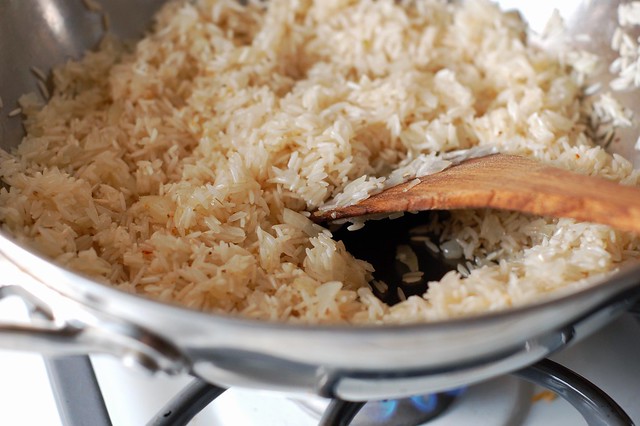
Sauteeing basmati rice in onion and peanut oil by Eve Fox, the Garden of Eating, copyright 2014

An important aside: if you have the freezer space, freeze whatever stock you have left over and use it next time you make this dish for even more flavorful chicken and rice. If you keep on doing this you'll end up with a kind of "master stock" that will really knock your socks off.

While the rice is cooking, you shred the meat. This is no small task! It took me about half an hour to pick the meat off my chicken although it was a whopper of a bird - more like a small turkey. By the end of the process, I had chicken under all my fingernails - not the most pleasant sensation. Luckily, I am washable. And I own a nailbrush.

Hainanese chicken with rice by Eve Fox, the Garden of Eating, copyright 2014

Then you whip up a simple but surprisingly addictive sauce of peanut oil, fresh ginger, scallions, a little rice mirin and some soy sauce. I like to do this a little bit in advance to allow some time for the flavors to meld. A note of caution to you: do not skimp on the dipping sauce! It's the key to the whole dish so you do not want to run out of it.
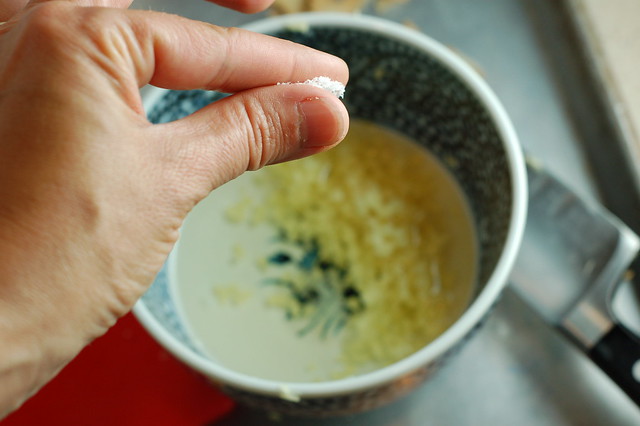
Adding salt to the gingery dipping sauce by Eve Fox, the Garden of Eating, copyright 2014

While the flavors are meeting and greeting over in dipping sauce land, chop up those cucumbers, tomatoes, scallions and cilantro.
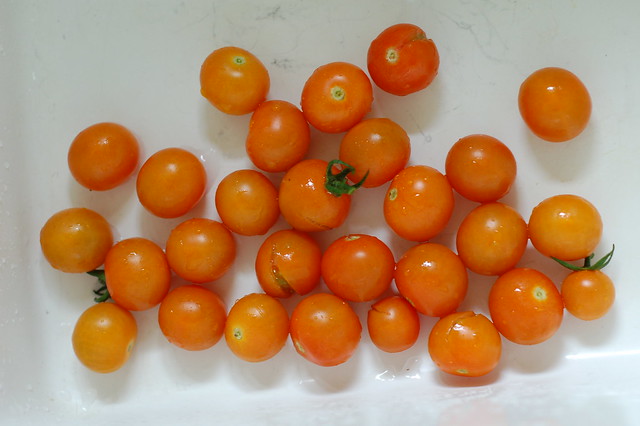
Sungold cherry tomatoes by Eve Fox, the Garden of Eating, copyright 2014

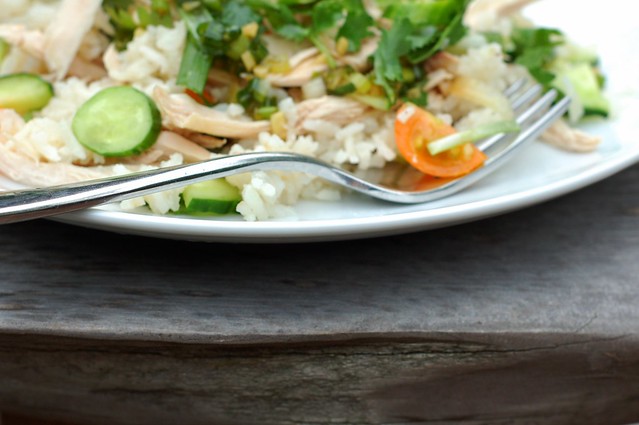
Now you're ready to compose your dish. Start by mounding the rice in the center of a large platter, top it with the shredded chicken, then arrange the cucumbers, tomatoes, scallions and cilantro in a sort of edible mandala. Serve your masterpiece with copious amounts of the ginger-scallion dipping sauce.

Hainanese chicken with rice by Eve Fox, the Garden of Eating, copyright 2014

-- print recipe --Hainanese Chicken with Rice lightly adapted from the New York Times
Serves 4-8

Ingredients

* 1 whole (3- to 4-pound) chicken, trimmed of excess fat
* Several cloves smashed garlic, plus 1 teaspoon minced garlic
* Several slices fresh ginger, plus 1 tablespoon minced ginger
* 1/2 cup peanut oil, or neutral oil, like corn or canola
* 3 shallots or a small onion, roughly chopped
* 2 cups long-grain rice (I used an organic white basmati)
* 1/2 cup minced scallions
* 2 cucumbers, sliced (peel them if they're from the supermarket but it's not necessary if they're from a farm or garden near you)
* 2 tomatoes, sliced
* Chopped fresh cilantro leaves
* 2 tablespoons sesame oil
* 2 tsps rice mirin
* 2 tsps soy or tamari sauce

Directions

1. Place the chicken in a large pot along with the smashed garlic, sliced ginger and a generous pinch of salt and cover it with water - just enough to submerge it. Cover it and bring the water to a boil then turn it down to medium and let it simmer for 10 minutes. Turn the heat off and leave the bird in the pot for 45 minutes to an hour, covered, or until it is cooked through. I was dealing with a rather oversized beast of a bird so I just extended all the cooking times by a bit. a large pot of water to a boil and salt it. Remove the chicken from the pot, leaving the stock and let the bird cool to room temperature.

2. Make the dipping sauce using 1/4 cup peanut oil, the minced ginger, half the scallions, a large pinch of salt, the soy sauce and rice mirin. Set it aside.

3. Put 1/4 cup peanut or other neutral oil in a large skillet over medium heat. When it's hot, add the minced garlic and the shallots or onions, cook, stirring occasionally, until lightly browned, about 4-5 minutes. Add the rice (I did not wash mine and it turned out great) and cook, stirring often for 2-3 minutes. Add 4 cups of the reserved chicken stock and bring to a boil, then reduce the heat to low and cover. Cook for about 20 minutes, until the rice has absorbed all the liquid. Stir in salt and pepper to taste.

4. While the rice is cooking, shred or chop the chicken, discarding the skin. Mound the rice on a large platter and top with the chicken, then decorate with the cucumbers, tomatoes, scallions and cilantro. Sprinkle the sesame oil over it all and serve with the dipping sauce.

You might also like:
For more delicious recipes, gardening ideas, foraging tips, and food-related inspiration "like" the Garden of Eating on Facebook, or follow me on Twitter and Pinterest.

How To Avoid Getting Poison Ivy

Monday, August 4, 2014

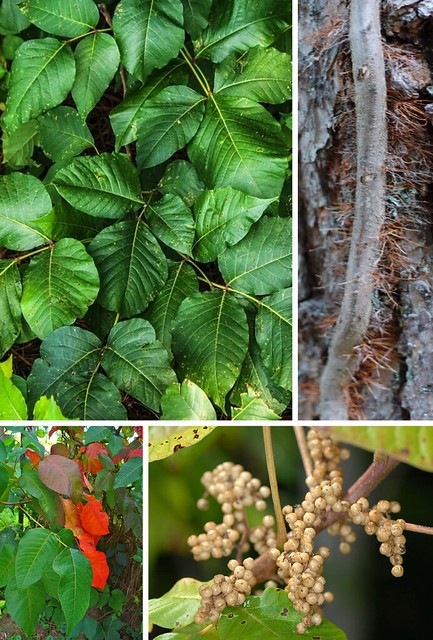
If you like to garden, hike, camp, forage or do yard work, there's a good chance you'll come into contact with poison ivy or poison oak - ivy's West Coast equivalent. And if you do, most of you will develop a very unpleasant, painfully itchy rash that will end up "weeping" (oozing fluid) and will take a hell of a lot longer to go away than you might like. This is caused by an oil called urushiol in the sap of the plant that causes a horrible allergic reaction in most humans although a lucky 20% are not allergic to it.

Can you spot poison ivy by Eve Fox, The Garden of Eating, copyright 2014

I, however, am definitely allergic to it. I spend a considerable amount of time outside in the yard, the garden, the woods, roadsides - weeding, planting, raking, foraging, picking and more. And I pull up poison ivy wherever I see it - which is everywhere... But so far, I've managed to avoid getting poison ivy almost entirely.

How, you ask? It's pretty simple:

1. I wear gloves to pull it out. If I know I'm going to be yanking up a bunch, I'll wear a pair of disposable latex gloves and, even though it's wasteful, I peel them off so that I'm left with two little balls of inside-out gloves and toss them in the garbage can we keep outside.

2. Before I take my gloves off, I wash the handles of any tools I've used thoroughly with Tecnu and give them a good rinse with the hose before hanging them up to dry. Then I get rid of the gloves.
3. As soon as I get inside, I strip and throw my clothes in the washing machine and add a splash of Tecnu to the water with the soap.

4. I wash my skin thoroughly with Tecnu.

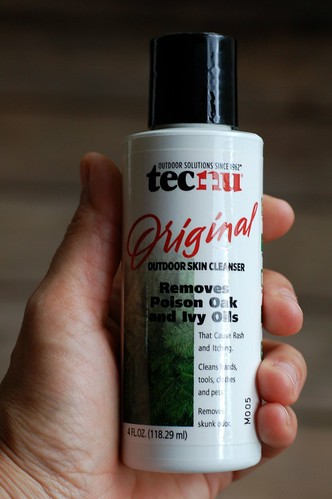
Ever since I found out that poison ivy is growing larger and more toxic as a result of climate change (yay, climate change!), I've been toying with the idea of buying stock in Tecnu. For now, I just buy it in bulk on Amazon.

Bottle of Tecnu by Eve Fox, The Garden of Eating, copyright 2014

If you're going to be outside, I highly recommend getting yourself a bottle of it. I also bought it in these little packets so I could put one in my backpack, one in the stroller, one in the glove compartment of the car. My husband thinks I'm crazy but sprinkling these packets around in a Boy Scout-like manner has helped ease my anxiety about my kids getting poison ivy considerably.

Tecnu packets by Eve Fox, The Garden of Eating, copyright 2014

If you do end up getting poison ivy, don't forget to wash the clothes you were wearing as the urushiol may still be on them, apply Calamine lotion liberally, and try not to scratch. If it's really bad, go see a doctor.

I had a terrible case of poison oak on my face when we lived in California and ended up going on corticosteroids for a short while because my eyes were swelling shut. While it's not something you should ever abuse, prednisone is completely magical! It helped tremendously and worked very quickly.

Just to clarify, I did not rub my face in poison oak leaves. I had my shirt tied around my waist and must've brushed against some poison oak while I was hiking and when I pulled the shirt on later, the urushiol oil got on my face. Oy!

You might also like:
For more delicious recipes, drool-worthy photos, garden tips, giveaways, and food-related inspiration "Like" the Garden of Eating on Facebook, or follow me on Twitter or Pinterest.

Wineberry Lemon Balm Sorbet - A Wildly Good, Healthy Dessert

Friday, August 1, 2014

Wineberry season is in full swing in our neck of the woods. A quick trip up to our mailbox and along the road yielded two big yogurt containers of these glistening, jewel-like fruits. When we got back, we checked for ticks to avoid the dreaded Lyme disease and washed exposed skin with Tecnu to avoid the dreaded poison ivy.
Picking wild wineberries by Eve Fox, The Garden of Eating, copyright 2014

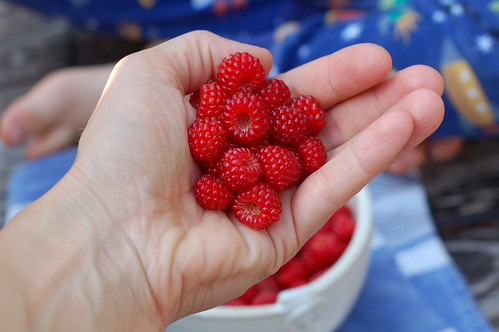
An interesting, if nerdy, aside, wineberries and their brambley cousins, raspberries, blackberries, black raspberries, thimbleberries, etc., are not actually berries. They are what is called an aggregate fruit made up of lots of drupelets (individual seeds wrapped in yummy, juicy flesh) around a central core. But I just think of them as berries.

A handful of wild wineberries by Eve Fox, The Garden of Eating, copyright 2014

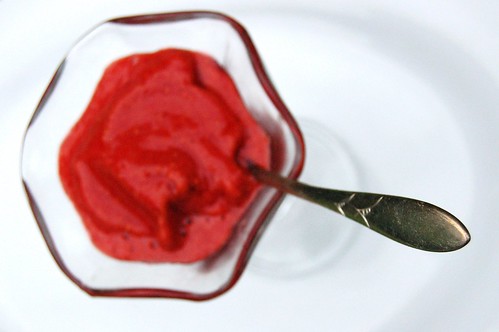
Anyway, back to the sorbet. We'd had such delicious results years ago with our wild blackberry sorbet that we decided to make it with some of our wineberry haul. And our five-year-old son was in on all the fun from start to finish. He even managed to contribute some berries instead of picking straight into his mouth like he usually does.

Wild wineberry lemon balm sorbet by Eve Fox, the Garden of Eating, copyright 2014

This kind of simple sorbet is very quick and easy though it melts super quickly so you have to eat it within minutes of getting it out of the food processor or blender. Not that that's any hardship...

Here's what you do:

Wash the "berries" and let them dry. Then arrange them in a single layer on a cookie sheet and put them in the freezer.

Freezing the wild wineberries to make sorbet by Eve Fox, The Garden of Eating, copyright 2014

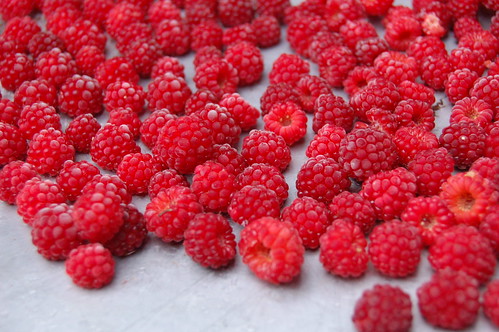
Once they're frozen solid, remove them and take a moment to enjoy their lightly frosted beauty.

Frozen wineberries by Eve Fox, the Garden of Eating, copyright 2014

Then scrape them all into the bowl of a cuisinart (you can use a blender but it's much tougher, slower going).

Dumping wineberries into the Cuisinart by Eve Fox, the Garden of Eating, copyright 2014

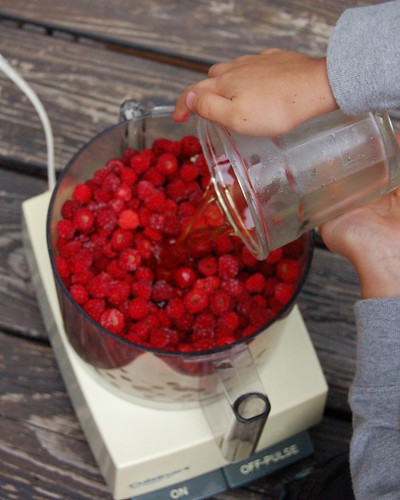
Add simple syrup or chilled maple syrup. I used the remainder of my delicious lemon balm simple syrup to lend a citrusy, herbaceous note to the sorbet.

Adding lemon balm simple syrup to the wineberry sorbet mixture by Eve Fox, the Garden of Eating, copyright 2014

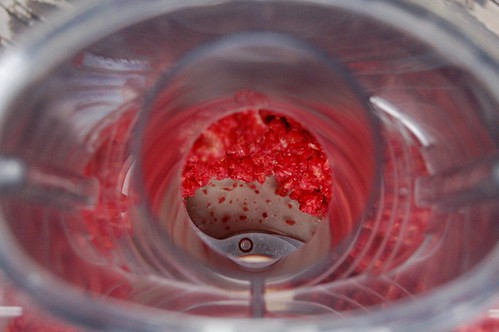
You may need to add a little ice water to get things moving but try to add as little as possible.

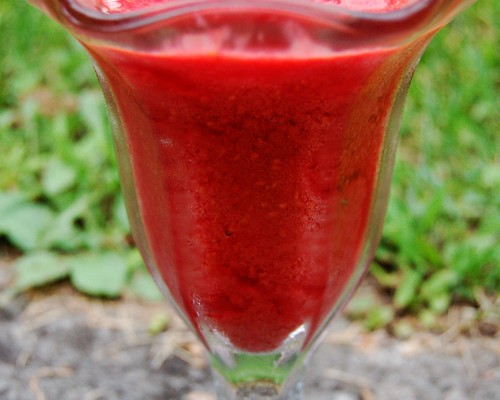
Blending the wild wineberry sorbet by Eve Fox, the Garden of Eating, copyright 2014

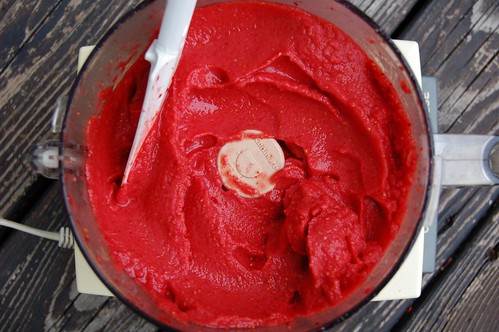
Blend it until it's smooth. There will still be seeds in it but we all enjoyed the little crunch they lend.

Blending the wild wineberry sorbet by Eve Fox, the Garden of Eating, copyright 2014

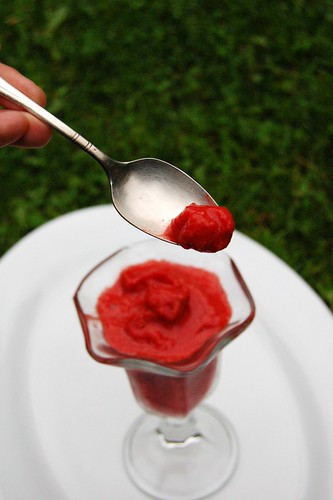
Put it in a bowl or a fancy glass and eat it before it melts. Or take your time, let it melt a bit and drink it, that's good, too.

Wild wineberry lemon balm sorbet by Eve Fox, the Garden of Eating, copyright 2014

The flavor is incomparable - sweet, of course, but with an indefinable slightly tart flavor that wakes up your mouth and makes you feel alive. Maybe it's the freshness, maybe it's the wild nature of the berries, I don't know. But it's really delicious.

Wild wineberry lemon balm sorbet by Eve Fox, the Garden of Eating, copyright 2014

I put what we did not scarf up into an ice cube tray to make some decadent wineberry lemon balm ice cubes to add to iced tea, lemonade or just a glass of seltzer for a refreshing treat.

Wild Wineberry Lemon Balm Sorbet
Serves 4

Ingredients

* 3 cups fresh wineberries, washed and dried
* 1/4 cup organic sugar
* 1/4 cup water
* A large handful of lemon balm leaves, washed and dried (optional - you can just make simple syrup if you prefer to leave the herby bit out)
* Ice water for blending

Directions
1. Lay the clean, drained berries in a single layer on a cookie sheet and place in the freezer until frozen through. It is best to do both this and the next step the day or night before you plan to make the sorbet - just make sure you leave enough time for everything to freeze.

2. Make the herb-infused simple syrup by combining the water, sugar and herbs in a small heavy-bottomed saucepot and heat over a medium flame until it comes to a boil. Turn it off and let cool completely then strain out the leaves and put the simple syrup in a jar with a lid (I love these glass working jars and lids) in the fridge to chill.

3. Once the berries are frozen and the simple syrup is cold, you can make the sorbet. Place the frozen berries and and the simple syrup in the bowl of a cuisinart or blender.  You may need to add a few teaspoons of ice water to aid in the blending. Continue to process or blend, adding small amounts of the ice water as needed, until smooth. Eat it right away!

You might also like:
For more delicious recipes, drool-worthy photos, giveaways, and food-related inspiration "Like" the Garden of Eating on Facebook, or follow me on Twitter or Pinterest.

Thursday, August 7, 2014

Hainanese Chicken with Rice - A Fresh, Flavorful Meal

Hainanese chicken with rice by Eve Fox, the Garden of Eating, copyright 2014

In my neverending quest to use up the cucumbers that are spilling out of our garden on a daily basis, I remembered this lovely dish that I had not made in many years. It's a variation on a one-pot meal that yields a beautiful, composed salad served with a gingery dipping sauce that is so fresh and flavorful that's rather addictive.

Cucumbers from the garden by Eve Fox, the Garden of Eating, copyright 2014

The recipe hails from the island of Hainan in the South China Sea and variations on it are also popular in Thailand, Malaysia and Singapore. I learned about it via a Mark Bittman column in the New York Times back in 2008.

In addition to being a very tasty way to showcase a bunch of fresh-picked, wonderfully crunchy cucumbers, it's a lovely way to feed a crowd. It earned rave reviews when I made it for dinner recently.

Scallions by Eve Fox, the Garden of Eating, copyright 2014

I love the mix of flavors - ginger, garlic, scallions, cilantro - and the mix of textures - crunchy cucumbers, juicy tomatoes, tender, poached chicken.

Smashing garlic by Eve Fox, the Garden of Eating, copyright 2014

The concept is simple. You start by poaching a whole chicken in a big pot of gingery, garlicky water. Then you take the bird out to cool, leaving you with a big pot of gingery, garlicky chicken stock.

Poached chicken by Eve Fox, the Garden of Eating, copyright 2014

Next you cut up some shallot or onion and garlic and sauté them for a few minutes before adding the rice and sautéing that for a minute or two. Then you add some of that nice, flavorful stock you've created in lieu of water.

Sauteeing basmati rice in onion and peanut oil by Eve Fox, the Garden of Eating, copyright 2014

An important aside: if you have the freezer space, freeze whatever stock you have left over and use it next time you make this dish for even more flavorful chicken and rice. If you keep on doing this you'll end up with a kind of "master stock" that will really knock your socks off.

While the rice is cooking, you shred the meat. This is no small task! It took me about half an hour to pick the meat off my chicken although it was a whopper of a bird - more like a small turkey. By the end of the process, I had chicken under all my fingernails - not the most pleasant sensation. Luckily, I am washable. And I own a nailbrush.

Hainanese chicken with rice by Eve Fox, the Garden of Eating, copyright 2014

Then you whip up a simple but surprisingly addictive sauce of peanut oil, fresh ginger, scallions, a little rice mirin and some soy sauce. I like to do this a little bit in advance to allow some time for the flavors to meld. A note of caution to you: do not skimp on the dipping sauce! It's the key to the whole dish so you do not want to run out of it.

Adding salt to the gingery dipping sauce by Eve Fox, the Garden of Eating, copyright 2014

While the flavors are meeting and greeting over in dipping sauce land, chop up those cucumbers, tomatoes, scallions and cilantro.

Sungold cherry tomatoes by Eve Fox, the Garden of Eating, copyright 2014

Now you're ready to compose your dish. Start by mounding the rice in the center of a large platter, top it with the shredded chicken, then arrange the cucumbers, tomatoes, scallions and cilantro in a sort of edible mandala. Serve your masterpiece with copious amounts of the ginger-scallion dipping sauce.

Hainanese chicken with rice by Eve Fox, the Garden of Eating, copyright 2014

-- print recipe --Hainanese Chicken with Rice lightly adapted from the New York Times
Serves 4-8

Ingredients

* 1 whole (3- to 4-pound) chicken, trimmed of excess fat
* Several cloves smashed garlic, plus 1 teaspoon minced garlic
* Several slices fresh ginger, plus 1 tablespoon minced ginger
* 1/2 cup peanut oil, or neutral oil, like corn or canola
* 3 shallots or a small onion, roughly chopped
* 2 cups long-grain rice (I used an organic white basmati)
* 1/2 cup minced scallions
* 2 cucumbers, sliced (peel them if they're from the supermarket but it's not necessary if they're from a farm or garden near you)
* 2 tomatoes, sliced
* Chopped fresh cilantro leaves
* 2 tablespoons sesame oil
* 2 tsps rice mirin
* 2 tsps soy or tamari sauce

Directions

1. Place the chicken in a large pot along with the smashed garlic, sliced ginger and a generous pinch of salt and cover it with water - just enough to submerge it. Cover it and bring the water to a boil then turn it down to medium and let it simmer for 10 minutes. Turn the heat off and leave the bird in the pot for 45 minutes to an hour, covered, or until it is cooked through. I was dealing with a rather oversized beast of a bird so I just extended all the cooking times by a bit. a large pot of water to a boil and salt it. Remove the chicken from the pot, leaving the stock and let the bird cool to room temperature.

2. Make the dipping sauce using 1/4 cup peanut oil, the minced ginger, half the scallions, a large pinch of salt, the soy sauce and rice mirin. Set it aside.

3. Put 1/4 cup peanut or other neutral oil in a large skillet over medium heat. When it's hot, add the minced garlic and the shallots or onions, cook, stirring occasionally, until lightly browned, about 4-5 minutes. Add the rice (I did not wash mine and it turned out great) and cook, stirring often for 2-3 minutes. Add 4 cups of the reserved chicken stock and bring to a boil, then reduce the heat to low and cover. Cook for about 20 minutes, until the rice has absorbed all the liquid. Stir in salt and pepper to taste.

4. While the rice is cooking, shred or chop the chicken, discarding the skin. Mound the rice on a large platter and top with the chicken, then decorate with the cucumbers, tomatoes, scallions and cilantro. Sprinkle the sesame oil over it all and serve with the dipping sauce.

You might also like:
For more delicious recipes, gardening ideas, foraging tips, and food-related inspiration "like" the Garden of Eating on Facebook, or follow me on Twitter and Pinterest.

Monday, August 4, 2014

How To Avoid Getting Poison Ivy

If you like to garden, hike, camp, forage or do yard work, there's a good chance you'll come into contact with poison ivy or poison oak - ivy's West Coast equivalent. And if you do, most of you will develop a very unpleasant, painfully itchy rash that will end up "weeping" (oozing fluid) and will take a hell of a lot longer to go away than you might like. This is caused by an oil called urushiol in the sap of the plant that causes a horrible allergic reaction in most humans although a lucky 20% are not allergic to it.

Can you spot poison ivy by Eve Fox, The Garden of Eating, copyright 2014

I, however, am definitely allergic to it. I spend a considerable amount of time outside in the yard, the garden, the woods, roadsides - weeding, planting, raking, foraging, picking and more. And I pull up poison ivy wherever I see it - which is everywhere... But so far, I've managed to avoid getting poison ivy almost entirely.

How, you ask? It's pretty simple:

1. I wear gloves to pull it out. If I know I'm going to be yanking up a bunch, I'll wear a pair of disposable latex gloves and, even though it's wasteful, I peel them off so that I'm left with two little balls of inside-out gloves and toss them in the garbage can we keep outside.

2. Before I take my gloves off, I wash the handles of any tools I've used thoroughly with Tecnu and give them a good rinse with the hose before hanging them up to dry. Then I get rid of the gloves.

3. As soon as I get inside, I strip and throw my clothes in the washing machine and add a splash of Tecnu to the water with the soap.

4. I wash my skin thoroughly with Tecnu.

Ever since I found out that poison ivy is growing larger and more toxic as a result of climate change (yay, climate change!), I've been toying with the idea of buying stock in Tecnu. For now, I just buy it in bulk on Amazon.

Bottle of Tecnu by Eve Fox, The Garden of Eating, copyright 2014

If you're going to be outside, I highly recommend getting yourself a bottle of it. I also bought it in these little packets so I could put one in my backpack, one in the stroller, one in the glove compartment of the car. My husband thinks I'm crazy but sprinkling these packets around in a Boy Scout-like manner has helped ease my anxiety about my kids getting poison ivy considerably.

Tecnu packets by Eve Fox, The Garden of Eating, copyright 2014

If you do end up getting poison ivy, don't forget to wash the clothes you were wearing as the urushiol may still be on them, apply Calamine lotion liberally, and try not to scratch. If it's really bad, go see a doctor.

I had a terrible case of poison oak on my face when we lived in California and ended up going on corticosteroids for a short while because my eyes were swelling shut. While it's not something you should ever abuse, prednisone is completely magical! It helped tremendously and worked very quickly.

Just to clarify, I did not rub my face in poison oak leaves. I had my shirt tied around my waist and must've brushed against some poison oak while I was hiking and when I pulled the shirt on later, the urushiol oil got on my face. Oy!

You might also like:
For more delicious recipes, drool-worthy photos, garden tips, giveaways, and food-related inspiration "Like" the Garden of Eating on Facebook, or follow me on Twitter or Pinterest.

Friday, August 1, 2014

Wineberry Lemon Balm Sorbet - A Wildly Good, Healthy Dessert

Wineberry season is in full swing in our neck of the woods. A quick trip up to our mailbox and along the road yielded two big yogurt containers of these glistening, jewel-like fruits. When we got back, we checked for ticks to avoid the dreaded Lyme disease and washed exposed skin with Tecnu to avoid the dreaded poison ivy.
Picking wild wineberries by Eve Fox, The Garden of Eating, copyright 2014

An interesting, if nerdy, aside, wineberries and their brambley cousins, raspberries, blackberries, black raspberries, thimbleberries, etc., are not actually berries. They are what is called an aggregate fruit made up of lots of drupelets (individual seeds wrapped in yummy, juicy flesh) around a central core. But I just think of them as berries.

A handful of wild wineberries by Eve Fox, The Garden of Eating, copyright 2014

Anyway, back to the sorbet. We'd had such delicious results years ago with our wild blackberry sorbet that we decided to make it with some of our wineberry haul. And our five-year-old son was in on all the fun from start to finish. He even managed to contribute some berries instead of picking straight into his mouth like he usually does.

Wild wineberry lemon balm sorbet by Eve Fox, the Garden of Eating, copyright 2014

This kind of simple sorbet is very quick and easy though it melts super quickly so you have to eat it within minutes of getting it out of the food processor or blender. Not that that's any hardship...

Here's what you do:

Wash the "berries" and let them dry. Then arrange them in a single layer on a cookie sheet and put them in the freezer.

Freezing the wild wineberries to make sorbet by Eve Fox, The Garden of Eating, copyright 2014

Once they're frozen solid, remove them and take a moment to enjoy their lightly frosted beauty.

Frozen wineberries by Eve Fox, the Garden of Eating, copyright 2014

Then scrape them all into the bowl of a cuisinart (you can use a blender but it's much tougher, slower going).

Dumping wineberries into the Cuisinart by Eve Fox, the Garden of Eating, copyright 2014

Add simple syrup or chilled maple syrup. I used the remainder of my delicious lemon balm simple syrup to lend a citrusy, herbaceous note to the sorbet.

Adding lemon balm simple syrup to the wineberry sorbet mixture by Eve Fox, the Garden of Eating, copyright 2014

You may need to add a little ice water to get things moving but try to add as little as possible.

Blending the wild wineberry sorbet by Eve Fox, the Garden of Eating, copyright 2014

Blend it until it's smooth. There will still be seeds in it but we all enjoyed the little crunch they lend.

Blending the wild wineberry sorbet by Eve Fox, the Garden of Eating, copyright 2014

Put it in a bowl or a fancy glass and eat it before it melts. Or take your time, let it melt a bit and drink it, that's good, too.

Wild wineberry lemon balm sorbet by Eve Fox, the Garden of Eating, copyright 2014

The flavor is incomparable - sweet, of course, but with an indefinable slightly tart flavor that wakes up your mouth and makes you feel alive. Maybe it's the freshness, maybe it's the wild nature of the berries, I don't know. But it's really delicious.

Wild wineberry lemon balm sorbet by Eve Fox, the Garden of Eating, copyright 2014

I put what we did not scarf up into an ice cube tray to make some decadent wineberry lemon balm ice cubes to add to iced tea, lemonade or just a glass of seltzer for a refreshing treat.

Wild Wineberry Lemon Balm Sorbet
Serves 4

Ingredients

* 3 cups fresh wineberries, washed and dried
* 1/4 cup organic sugar
* 1/4 cup water
* A large handful of lemon balm leaves, washed and dried (optional - you can just make simple syrup if you prefer to leave the herby bit out)
* Ice water for blending

Directions
1. Lay the clean, drained berries in a single layer on a cookie sheet and place in the freezer until frozen through. It is best to do both this and the next step the day or night before you plan to make the sorbet - just make sure you leave enough time for everything to freeze.

2. Make the herb-infused simple syrup by combining the water, sugar and herbs in a small heavy-bottomed saucepot and heat over a medium flame until it comes to a boil. Turn it off and let cool completely then strain out the leaves and put the simple syrup in a jar with a lid (I love these glass working jars and lids) in the fridge to chill.

3. Once the berries are frozen and the simple syrup is cold, you can make the sorbet. Place the frozen berries and and the simple syrup in the bowl of a cuisinart or blender.  You may need to add a few teaspoons of ice water to aid in the blending. Continue to process or blend, adding small amounts of the ice water as needed, until smooth. Eat it right away!

You might also like:
For more delicious recipes, drool-worthy photos, giveaways, and food-related inspiration "Like" the Garden of Eating on Facebook, or follow me on Twitter or Pinterest.