The Great Sweet Potato Experiment

Wednesday, May 28, 2014

In case you missed the backstory, I am experimenting with attempting to use sweet potatoes to outcompete a crapload of Japanese Silvergrass and lemon balm that had completely taken over all the garden beds at our new house. You can catch up here if that's too vague for you.

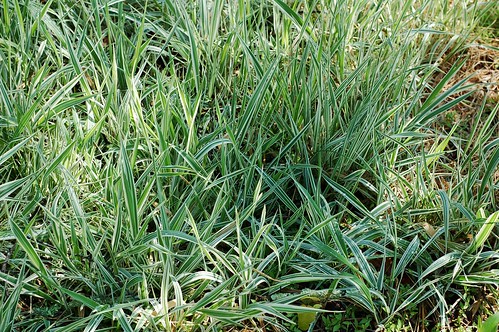
Japanese silvergrass by Eve Fox, the Garden of Eating blog, copyright 2014

I've never grown sweet potatoes before but learned that most people buy their sweet potato slips (which is what the part that you plant is called) from seed suppliers. But I found a great post about growing your own sweet potatoes on Outlaw Garden so we're giving it a shot. If it doesn't work, I'll order some slips once it's closer to planting time -- because they're tropical plants, they need the ground to be nice and warm before you can plant them - so we're looking at sometime in June.
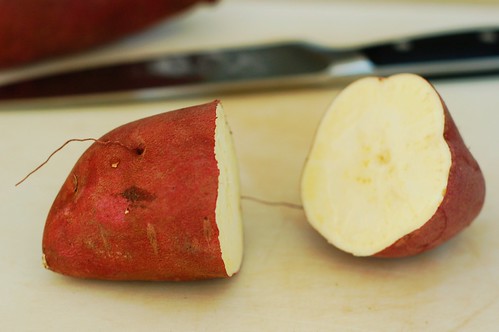
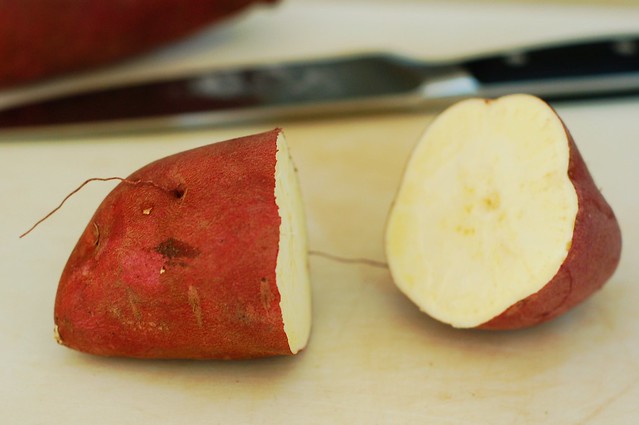
Cutting the sweet potatoes in half by Eve Fox, the Garden of Eating blog, copyright 2014

About a month ago, I bought some organic sweet potatoes at Sunflower, cut them in half and put them cut-side down in a Pyrex lasagna tray filled with water per Outlaw Garden's instructions.

It was a bit slow at first but sure enough, thin white roots began snaking out from the cut ends submerged in the water.
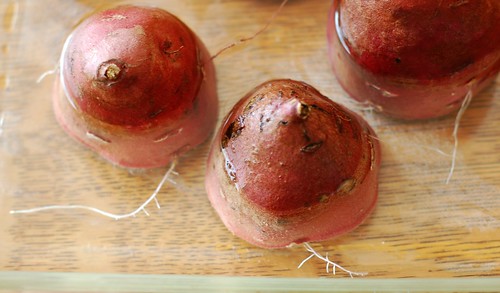
Sweet potatoes sprouting by Eve Fox, the Garden of Eating blog, copyright 2014

The roots multiplied and grew thicker and the tops began to send out tentative feelers that unfurled into lovely, delicate purple-veined leaves that fade to green as they grow.
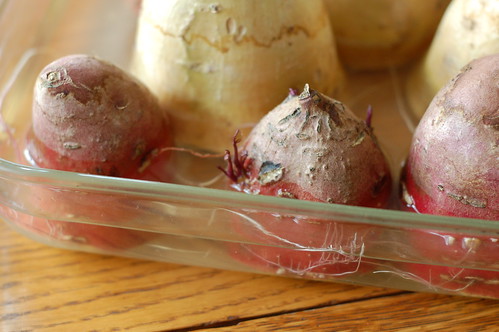
Sweet potatoes sprouting by Eve Fox, the Garden of Eating blog, copyright 2014

As the weather has warmed, they've started to take off, sending up shoots and lush, green leaves tipped with purple. It's been very fun to watch them grow and our five-year-old is following along with interest.
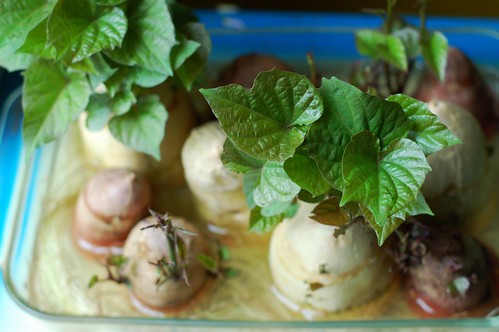
Sweet potatoes sprouting slips by Eve Fox, the Garden of Eating blog, copyright 2014

After another couple weeks of growth, the first slips had sprouted roots from the bases of their leaves -- these are different from the roots that sprouted from the cut ends of the potatoes. This was the sign I'd been waiting for that they were ready to plant in small pots which should give them a chance to get even more established before they go into the ground in a few weeks or so.
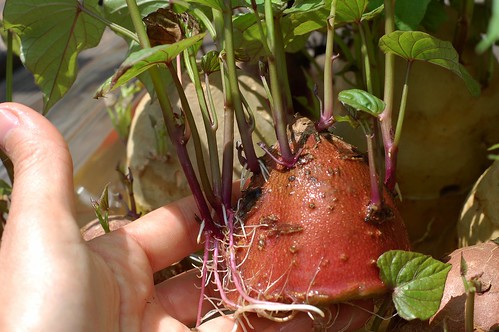
Sweet potato slips by Eve Fox, the Garden of Eating blog, copyright 2014

I cut the slips off and planted them in some mushroom dirt then put the potatoes back into the water so the other sprouts could continue to grow.
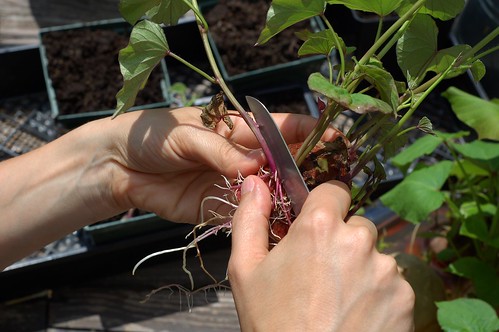
Cutting sweet potato slips for planting by Eve Fox, the Garden of Eating blog, copyright 2014

I'm still waiting for the yellow sweet potato shoots to sprout roots from the base of the slips - so far it's just been the purple skinned ones that made the move.
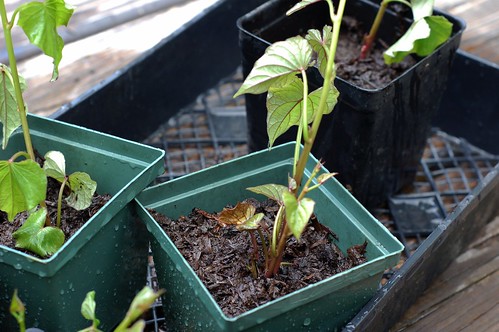
Sweet potato slips planted by Eve Fox, the Garden of Eating blog, copyright 2014

And more good news -- since sweet potatoes thrive in hot weather and warm soil, several of my trusted gardening sources (Maggie and Leila, I'm looking at you two) have recommended planting the slips in holes cut in either black plastic or cardboard. And, in case you hadn't noticed, I happen to have quite a lot of cardboard lying around these days... The hope is twofold: that the cardboard will help keep the heat-loving plants toasty and happy while also depriving the Japanese silvergrass, lemon balm and anything else we'd like to say goodbye to of life-giving sunlight.

We shall see... I'll keep you posted.
---------------------------------

Find out what happened below.

Part II: Sweet Potatoes Are In The Ground!
Part III: Sweet Potato Harvest!!!

You might also like:
Want even more recipes, photos, giveaways, and food-related inspiration? "Like" the Garden of Eating on Facebook, or follow me on Twitter or Pinterest.

Garden Reclamation: Trying to Get Rid of Aggressive Invasives

Tuesday, May 27, 2014

We've been battling a number of rather aggressive plants since we moved into our house last summer. I think there should be a special place reserved in Hell for whoever planted all the Japanese Barberry bushes and Japanese variegated silver grass all around the house... (no offense to the Japanese - I'm sure they're not responsible for bringing them here and they definitely didn't plant them all around my house.)

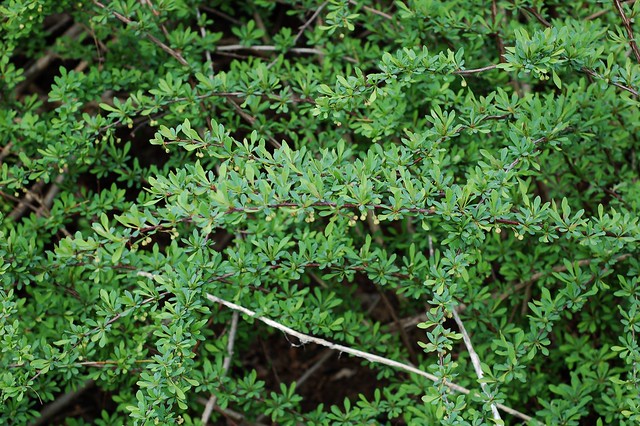
Japanese Barberry by Eve Fox, the Garden of Eating blog, copyright 2014

I've never liked Japanese barberry -- why would you choose to plant a big prickerbush in your yard??? -- but now that I know that barberries serve as nurseries for the black legged a.k.a. "deer" tick - one of the main vectors for Lyme disease, babesiosis and granulocytic anaplasmosis - I like them even less... Worse still, they spread like wildfire - not only do we have them in our yard where some idiot actually planted them, we now have them all throughout our woods...

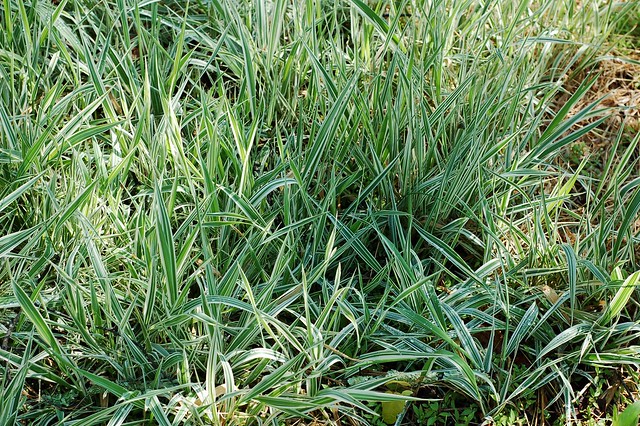
The Japanese silvergrass is a little less offensive -- it's pretty, it has no thorns and no known link to Lyme disease. And I have a grudging respect for its ability to grow and thrive in the crappiest of soils. Pure clay with some rocks mixed in? No problem! And where its roots go, the earthworms follow. I should know, I've pulled enough of them out...

Japanese silvergrass by Eve Fox, the Garden of Eating blog, copyright 2014

But man, does it take over! There is a sea of it in all the garden beds and it is nigh unto impossible to get rid of as it will sprout again from the tiniest piece left in the soil. It is truly the Terminator of ornamental grasses. And it's also spread to several parts of the woods, undoubtedly where it was unwittingly dropped by previous gardeners after attempting to weed it.

Last summer, I managed to remove most of the Japanese silvergrass from the rocky planting area in our backyard. I'll never get it all since its rhizomes grow right under some of these massive rocks and there is just no lifting them. I'm resigned to simply pulling out the shoots wherever they appear - for the rest of my life...

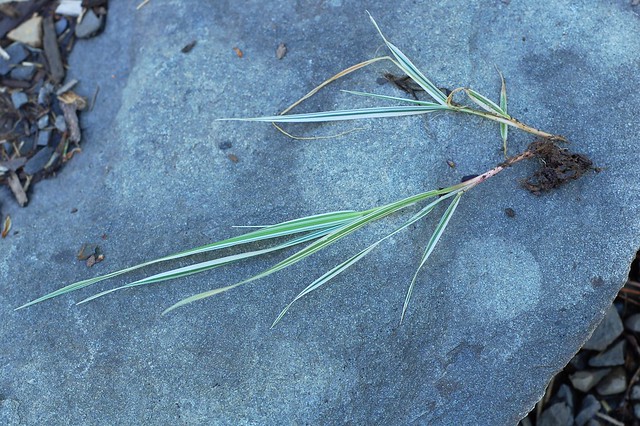
Japanese silvergrass poking up by Eve Fox, the Garden of Eating blog, copyright 2014
Leaving a shoot of Japanese silvergrass to die (hopefully) by Eve Fox, the Garden of Eating blog, copyright 2014

The garden beds in the front yard are an even bigger challenge. At first, I just kind of wanted to give up, overwhelmed by the enormity of the weeding task ahead of me. I mean, look at this! And this is just a little portion of it...

Garden bed overgrown with silvergrass by Eve Fox, the Garden of Eating blog, copyright 2014

And it's not just silvergrass, there's also quite a bit of lemon balm (another big taker over - but one that I at least like since it smells nice and you can eat it) and some unidentified but very spiky weed mixed into the mess. Here's some lemon balm with a little silvergrass.

Lemon balm by Eve Fox, Garden of Eating blog, copyright 2013

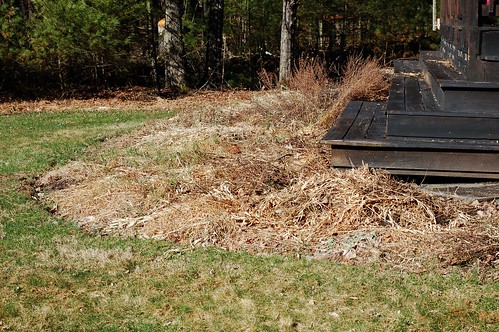
But then I started to weed it in sections. I found that it was a little easier to pull out than I'd expected since the soil was richer than in the backyard where it was all clay and rocks. And, of course, it was immensely satisfying. Once I'd dug out everything I could get, I covered what I'd weeded with cardboard to deprive whatever was left of sunlight and moved on.

Weeded beds covered with cardboard by Eve Fox, the Garden of Eating blog, copyright 2014

Meanwhile, I read up on rhizomatous grasses. The most common ones people love to hate are Bermuda grass, crab grass, and quackgrass. And, as with the silvergrass, they are basically impossible to get rid of. But then I happened on a thread where someone talked about planting sweet potatoes as a way of trying to outcompete Bermuda grass. It seems that sweet potatoes have these pretty vines that will pretty much take over whatever space they're allotted and squeeze out the weeds.

So I decided it was worth a shot. We're at the early stages of the great Sweet Potato Experiment right now but I figured I'd write about it in case it ends up working and you want to follow along. I'll be posting more about it soon.

Cutting the sweet potatoes in half by Eve Fox, the Garden of Eating blog, copyright 2014

Update: It totally worked! You can read all about it here.

You might also like:
For more delicious recipes, gardening ideas, foraging tips, and food-related inspiration "like" the Garden of Eating on Facebook, or follow me on Twitter and Pinterest.

Stir-Fried Garlic Spinach - the Pinnacle of Yum

Monday, May 19, 2014

This spinach has earned a permanent place in my kitchen repertoire. It's so tasty, so fast and so easy that I just can't quit it. Not that I'd ever want to quit it...

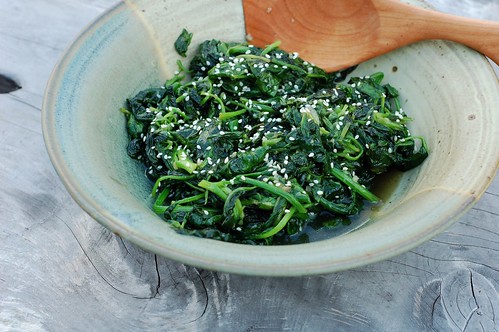
Auntie Yi's Stir-Fried Garlic Spinach by Eve Fox, the Garden of Eating blog, copyright 2014

It comes by way of Grace Young's lovely cookbook, The Breath of a Wok, which my husband gave me as a gift after we returned from a trip to Southeast Asia what feels like a lifetime ago (we were so young...)
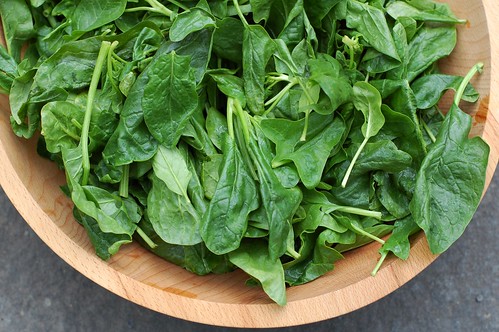
I've been making Auntie Yi's Stir-Fried Garlic Spinach ever since. It's so easy that I always feel a little like I'm cheating somehow. The seasoning is incredibly simple - a tablespoon of rice mirin mixed with equal parts sugar and salt.

There are just two things that you need to do to make this a truly stand-out dish:

1. Use really fresh, flavorful spinach - it makes a huge difference in the taste.
2. Get your wok (or wide, flat-bottomed pan if you don't have a wok) really, really hot and don't crowd the spinach. If you want to make more than one bunch of spinach, do it in two batches to ensure you can really stir-fry it effectively.

Gorgeous first spinach of the season from Taliaferro farms by Eve Fox, the Garden of Eating blog, copyright 2014

When I saw the first spinach of the season from Taliaferro Farms in the produce section of my health food store last week, looking all gorgeous and tender and a practically radioactive shade of green that only occurs in the spring, I knew this would be on the menu.

A little washing and drying, chopping, mixing and stir-frying and BOOM, we were in business.

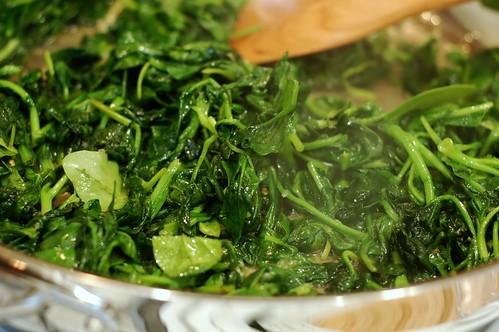
Frying the spinach by Eve Fox, the Garden of Eating blog, copyright 2014

As always, it was SO GOOD!

Auntie Yi's Stir-Fried Garlic Spinach by Eve Fox, the Garden of Eating blog, copyright 2014

Stir-Fried Garlic Spinach minimally adapted from Grace Young's excellent book The Breath of a Wok
Serves 4 as a side

Ingredients

* 2 Tbsp vegetable or peanut oil
* 1 Tbsp minced garlic
* 1 bunch fresh spinach (about 10 ounces)
* 1/2 tsp sea salt
* 1/2 tsp cane sugar
* 1 Tbsp rice mirin or dry sherry
* 1-2 tsps toasted sesame seeds (optional)

Directions

1. Heat a 14-inch flat bottomed wok over high heat until a bead of water vaporizes within 1 to 2 seconds of contact. Swirl in the oil, add the garlic and stir-fry for 10 seconds.

2. Add all the spinach and stir-fry for 10 seconds.

3. Add the salt, sugar and rice wine and stir-fry for 1-2 minutes or until the spinach is just tender but still bright green. Garnish with the sesame seeds (if you like them, that is) and serve.

You might also like:

For even more recipes, photos, giveaways, and food-related inspiration "Like" the Garden of Eating on Facebook, or follow me on Twitter or Pinterest.

Wednesday, May 28, 2014

The Great Sweet Potato Experiment

In case you missed the backstory, I am experimenting with attempting to use sweet potatoes to outcompete a crapload of Japanese Silvergrass and lemon balm that had completely taken over all the garden beds at our new house. You can catch up here if that's too vague for you.

Japanese silvergrass by Eve Fox, the Garden of Eating blog, copyright 2014

I've never grown sweet potatoes before but learned that most people buy their sweet potato slips (which is what the part that you plant is called) from seed suppliers. But I found a great post about growing your own sweet potatoes on Outlaw Garden so we're giving it a shot. If it doesn't work, I'll order some slips once it's closer to planting time -- because they're tropical plants, they need the ground to be nice and warm before you can plant them - so we're looking at sometime in June.

Cutting the sweet potatoes in half by Eve Fox, the Garden of Eating blog, copyright 2014

About a month ago, I bought some organic sweet potatoes at Sunflower, cut them in half and put them cut-side down in a Pyrex lasagna tray filled with water per Outlaw Garden's instructions.

It was a bit slow at first but sure enough, thin white roots began snaking out from the cut ends submerged in the water.

Sweet potatoes sprouting by Eve Fox, the Garden of Eating blog, copyright 2014

The roots multiplied and grew thicker and the tops began to send out tentative feelers that unfurled into lovely, delicate purple-veined leaves that fade to green as they grow.

Sweet potatoes sprouting by Eve Fox, the Garden of Eating blog, copyright 2014

As the weather has warmed, they've started to take off, sending up shoots and lush, green leaves tipped with purple. It's been very fun to watch them grow and our five-year-old is following along with interest.

Sweet potatoes sprouting slips by Eve Fox, the Garden of Eating blog, copyright 2014

After another couple weeks of growth, the first slips had sprouted roots from the bases of their leaves -- these are different from the roots that sprouted from the cut ends of the potatoes. This was the sign I'd been waiting for that they were ready to plant in small pots which should give them a chance to get even more established before they go into the ground in a few weeks or so.

Sweet potato slips by Eve Fox, the Garden of Eating blog, copyright 2014

I cut the slips off and planted them in some mushroom dirt then put the potatoes back into the water so the other sprouts could continue to grow.

Cutting sweet potato slips for planting by Eve Fox, the Garden of Eating blog, copyright 2014

I'm still waiting for the yellow sweet potato shoots to sprout roots from the base of the slips - so far it's just been the purple skinned ones that made the move.

Sweet potato slips planted by Eve Fox, the Garden of Eating blog, copyright 2014

And more good news -- since sweet potatoes thrive in hot weather and warm soil, several of my trusted gardening sources (Maggie and Leila, I'm looking at you two) have recommended planting the slips in holes cut in either black plastic or cardboard. And, in case you hadn't noticed, I happen to have quite a lot of cardboard lying around these days... The hope is twofold: that the cardboard will help keep the heat-loving plants toasty and happy while also depriving the Japanese silvergrass, lemon balm and anything else we'd like to say goodbye to of life-giving sunlight.

We shall see... I'll keep you posted.
---------------------------------

Find out what happened below.

Part II: Sweet Potatoes Are In The Ground!
Part III: Sweet Potato Harvest!!!

You might also like:
Want even more recipes, photos, giveaways, and food-related inspiration? "Like" the Garden of Eating on Facebook, or follow me on Twitter or Pinterest.

Tuesday, May 27, 2014

Garden Reclamation: Trying to Get Rid of Aggressive Invasives

We've been battling a number of rather aggressive plants since we moved into our house last summer. I think there should be a special place reserved in Hell for whoever planted all the Japanese Barberry bushes and Japanese variegated silver grass all around the house... (no offense to the Japanese - I'm sure they're not responsible for bringing them here and they definitely didn't plant them all around my house.)

Japanese Barberry by Eve Fox, the Garden of Eating blog, copyright 2014

I've never liked Japanese barberry -- why would you choose to plant a big prickerbush in your yard??? -- but now that I know that barberries serve as nurseries for the black legged a.k.a. "deer" tick - one of the main vectors for Lyme disease, babesiosis and granulocytic anaplasmosis - I like them even less... Worse still, they spread like wildfire - not only do we have them in our yard where some idiot actually planted them, we now have them all throughout our woods...

The Japanese silvergrass is a little less offensive -- it's pretty, it has no thorns and no known link to Lyme disease. And I have a grudging respect for its ability to grow and thrive in the crappiest of soils. Pure clay with some rocks mixed in? No problem! And where its roots go, the earthworms follow. I should know, I've pulled enough of them out...

Japanese silvergrass by Eve Fox, the Garden of Eating blog, copyright 2014

But man, does it take over! There is a sea of it in all the garden beds and it is nigh unto impossible to get rid of as it will sprout again from the tiniest piece left in the soil. It is truly the Terminator of ornamental grasses. And it's also spread to several parts of the woods, undoubtedly where it was unwittingly dropped by previous gardeners after attempting to weed it.

Last summer, I managed to remove most of the Japanese silvergrass from the rocky planting area in our backyard. I'll never get it all since its rhizomes grow right under some of these massive rocks and there is just no lifting them. I'm resigned to simply pulling out the shoots wherever they appear - for the rest of my life...

Japanese silvergrass poking up by Eve Fox, the Garden of Eating blog, copyright 2014
Leaving a shoot of Japanese silvergrass to die (hopefully) by Eve Fox, the Garden of Eating blog, copyright 2014

The garden beds in the front yard are an even bigger challenge. At first, I just kind of wanted to give up, overwhelmed by the enormity of the weeding task ahead of me. I mean, look at this! And this is just a little portion of it...

Garden bed overgrown with silvergrass by Eve Fox, the Garden of Eating blog, copyright 2014

And it's not just silvergrass, there's also quite a bit of lemon balm (another big taker over - but one that I at least like since it smells nice and you can eat it) and some unidentified but very spiky weed mixed into the mess. Here's some lemon balm with a little silvergrass.

Lemon balm by Eve Fox, Garden of Eating blog, copyright 2013

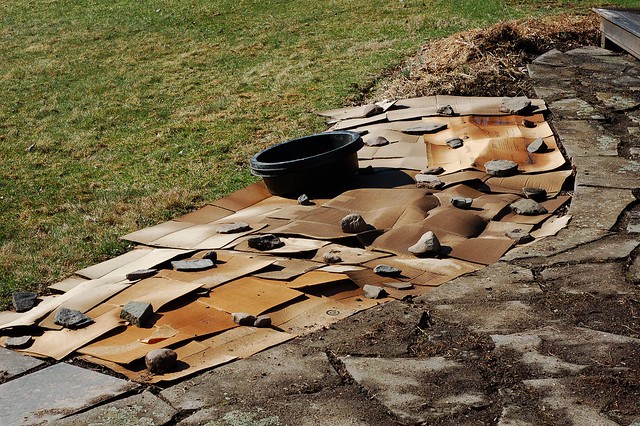
But then I started to weed it in sections. I found that it was a little easier to pull out than I'd expected since the soil was richer than in the backyard where it was all clay and rocks. And, of course, it was immensely satisfying. Once I'd dug out everything I could get, I covered what I'd weeded with cardboard to deprive whatever was left of sunlight and moved on.

Weeded beds covered with cardboard by Eve Fox, the Garden of Eating blog, copyright 2014

Meanwhile, I read up on rhizomatous grasses. The most common ones people love to hate are Bermuda grass, crab grass, and quackgrass. And, as with the silvergrass, they are basically impossible to get rid of. But then I happened on a thread where someone talked about planting sweet potatoes as a way of trying to outcompete Bermuda grass. It seems that sweet potatoes have these pretty vines that will pretty much take over whatever space they're allotted and squeeze out the weeds.

So I decided it was worth a shot. We're at the early stages of the great Sweet Potato Experiment right now but I figured I'd write about it in case it ends up working and you want to follow along. I'll be posting more about it soon.

Cutting the sweet potatoes in half by Eve Fox, the Garden of Eating blog, copyright 2014

Update: It totally worked! You can read all about it here.

You might also like:
For more delicious recipes, gardening ideas, foraging tips, and food-related inspiration "like" the Garden of Eating on Facebook, or follow me on Twitter and Pinterest.

Monday, May 19, 2014

Stir-Fried Garlic Spinach - the Pinnacle of Yum

This spinach has earned a permanent place in my kitchen repertoire. It's so tasty, so fast and so easy that I just can't quit it. Not that I'd ever want to quit it...

Auntie Yi's Stir-Fried Garlic Spinach by Eve Fox, the Garden of Eating blog, copyright 2014

It comes by way of Grace Young's lovely cookbook, The Breath of a Wok, which my husband gave me as a gift after we returned from a trip to Southeast Asia what feels like a lifetime ago (we were so young...)

I've been making Auntie Yi's Stir-Fried Garlic Spinach ever since. It's so easy that I always feel a little like I'm cheating somehow. The seasoning is incredibly simple - a tablespoon of rice mirin mixed with equal parts sugar and salt.

There are just two things that you need to do to make this a truly stand-out dish:

1. Use really fresh, flavorful spinach - it makes a huge difference in the taste.
2. Get your wok (or wide, flat-bottomed pan if you don't have a wok) really, really hot and don't crowd the spinach. If you want to make more than one bunch of spinach, do it in two batches to ensure you can really stir-fry it effectively.

Gorgeous first spinach of the season from Taliaferro farms by Eve Fox, the Garden of Eating blog, copyright 2014

When I saw the first spinach of the season from Taliaferro Farms in the produce section of my health food store last week, looking all gorgeous and tender and a practically radioactive shade of green that only occurs in the spring, I knew this would be on the menu.

A little washing and drying, chopping, mixing and stir-frying and BOOM, we were in business.

Frying the spinach by Eve Fox, the Garden of Eating blog, copyright 2014

As always, it was SO GOOD!

Auntie Yi's Stir-Fried Garlic Spinach by Eve Fox, the Garden of Eating blog, copyright 2014

Stir-Fried Garlic Spinach minimally adapted from Grace Young's excellent book The Breath of a Wok
Serves 4 as a side

Ingredients

* 2 Tbsp vegetable or peanut oil
* 1 Tbsp minced garlic
* 1 bunch fresh spinach (about 10 ounces)
* 1/2 tsp sea salt
* 1/2 tsp cane sugar
* 1 Tbsp rice mirin or dry sherry
* 1-2 tsps toasted sesame seeds (optional)

Directions

1. Heat a 14-inch flat bottomed wok over high heat until a bead of water vaporizes within 1 to 2 seconds of contact. Swirl in the oil, add the garlic and stir-fry for 10 seconds.

2. Add all the spinach and stir-fry for 10 seconds.

3. Add the salt, sugar and rice wine and stir-fry for 1-2 minutes or until the spinach is just tender but still bright green. Garnish with the sesame seeds (if you like them, that is) and serve.

You might also like:

For even more recipes, photos, giveaways, and food-related inspiration "Like" the Garden of Eating on Facebook, or follow me on Twitter or Pinterest.